PraneoTech
Omnipoints
Building the operational layer behind a closed-loop loyalty ecosystem
1. Title & Executive Summary
OmniPoints is a loyalty and rewards platform built to power the rewards ecosystem behind the Omniuse mobile application. The Omniuse application generates user activities, while OmniPoints manages the underlying points economy, rewards, merchant offers, voucher redemption, partner operations, and integrations. The platform connects consumer engagement with real-world merchant fulfillment through a controlled workflow from earning points to redeeming and verifying rewards. Praneo Tech's work focused on building the platform that connects these participants while keeping the loyalty lifecycle consistent across applications, merchants, and operators.
2. Context & Background
The product ecosystem
OmniPoints operates as the loyalty platform behind the Omniuse mobile experience.
The ecosystem consists of three primary participants:
Omniuse Mobile Application: The consumer-facing application where users perform activities and engage with the loyalty experience.
OmniPoints: The operational platform responsible for points, rewards, redemptions, merchant partnerships, and program administration.
Partner Merchants: Businesses that provide rewards and verify customer vouchers when rewards are redeemed.
This creates a simple relationship:
Omniuse → OmniPoints → Partner Merchant
Our role
Praneo Tech was responsible for designing and developing the OmniPoints platform and its operational workflows. The work covered the platform's administrative experience, merchant-facing functionality, loyalty workflows, integrations, and transaction lifecycle.
3. The Technical Problem
A loyalty program is more than a points balance
The initial challenge was to create an operational layer between a consumer application and physical merchant fulfillment. Omniuse could generate activities and user engagement, but the loyalty program also needed to reliably handle what happened after those activities occurred.
The platform needed to answer questions such as:
How should an activity become points?
How should users spend those points?
How should rewards be reserved while a redemption is pending?
How does a merchant verify that a reward is valid?
What happens when a voucher expires or is cancelled?
How is partner funding accounted for?
How can operators monitor the overall loyalty ecosystem?
How can external systems communicate with the platform reliably?
The core challenge
The fundamental problem was connecting several independently operating parts of the ecosystem:
User activity → Points → Reward → Voucher → Merchant fulfillment
Each stage has different responsibilities, but the resulting transaction must remain consistent across the entire lifecycle.
Business impact
Without a dedicated operational layer, loyalty functionality would become tightly coupled to the consumer application and increasingly difficult to operate as partners, rewards, and integrations were added. OmniPoints was therefore designed as a dedicated platform rather than embedding the entire loyalty economy inside the mobile application.
4. The Proposed Strategy & Decision
Separate engagement from loyalty operations
The central architectural decision was to separate the consumer experience from the loyalty operating system. Omniuse remains focused on user engagement. OmniPoints owns the loyalty lifecycle. Merchants interact with OmniPoints to fulfill rewards. This separation allows each part of the ecosystem to evolve independently while maintaining a consistent source of truth for loyalty transactions.
Core platform capabilities
The platform was designed around several major capabilities:
Activity & points management: Activities originating from the Omniuse ecosystem can be processed into points while maintaining a reliable transaction history.
Rewards & redemption: Users can access available offers and exchange points for participating merchant rewards.
Voucher fulfillment: Redeemed offers generate digital vouchers that can subsequently be verified by participating merchants.
Partner economics: The platform accounts for partner reward funding and the value committed during the redemption lifecycle.
Merchant operations: Partners receive dedicated functionality for verifying rewards, monitoring claims, managing offers, and accessing support.
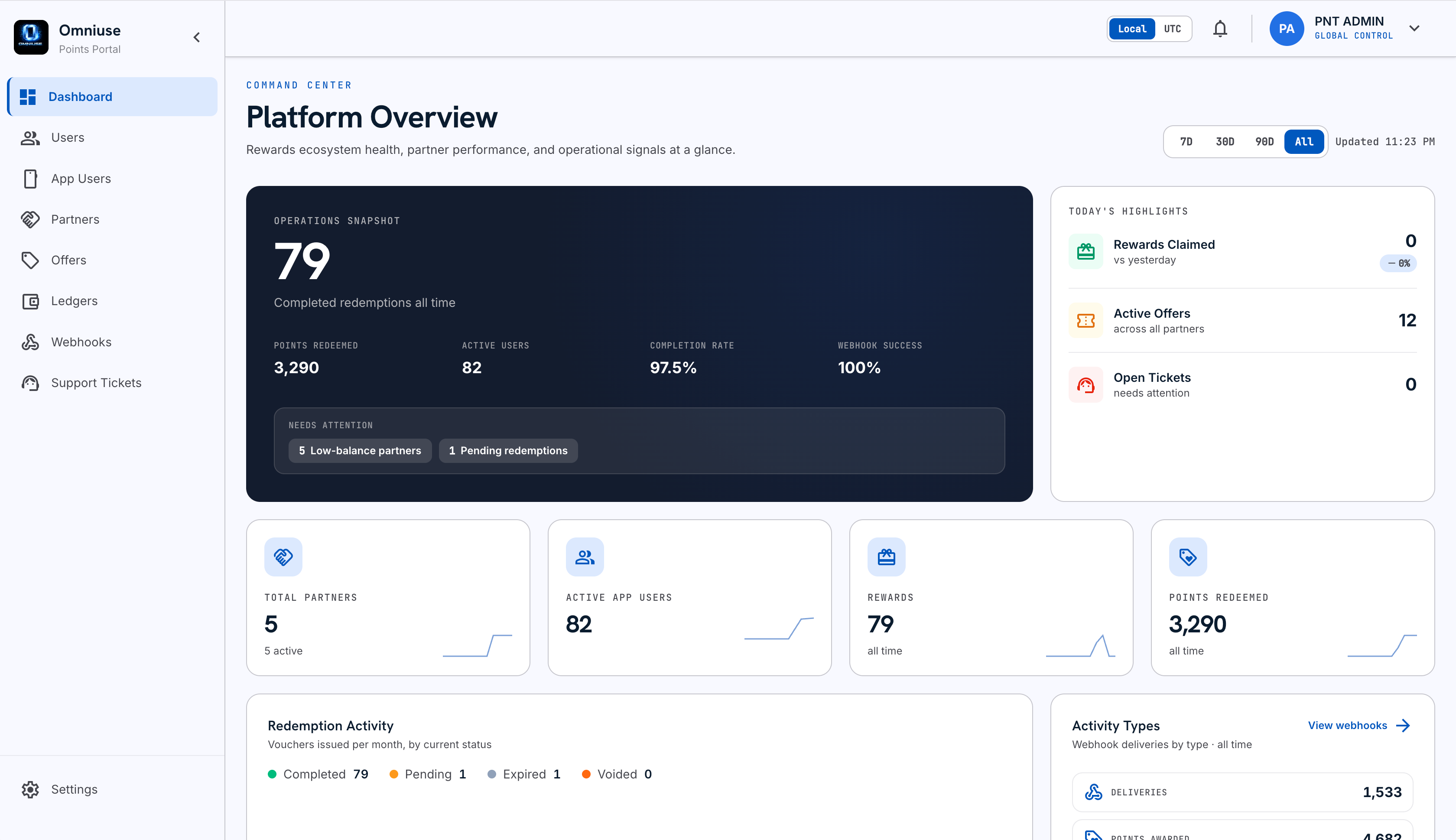
Platform administration: Operators can manage users, partners, rewards, transactions, integrations, configuration, and operational support from a centralized workspace.
5. Implementation & Execution

Phase 1: Loyalty foundation
The first stage established the core concepts required to operate the loyalty economy:
User points
Activities
Rewards
Transactions
Redemptions
Partner relationships
The objective was to establish a consistent lifecycle before adding operational interfaces.
Phase 2: Redemption lifecycle
The redemption workflow was then built around a controlled reservation model. When a user claims a reward, the required value is committed while the voucher remains pending. A successful merchant verification completes the transaction. An expired or cancelled redemption can release the reserved value.This provides a controlled lifecycle:
Available → Reserved → Redeemed
Phase 3: Merchant experience
The merchant-facing experience was introduced to connect digital rewards with physical fulfillment. Partners can verify vouchers using a code or QR-based workflow and review their reward activity through their workspace. The goal was to make the merchant side considerably simpler than the underlying platform required to support it.
Phase 4: Administrative operations
The platform administration experience brought the remaining operational responsibilities together. Operators can manage:
Partners
Rewards
Users
Transactions
Program configuration
Integrations
Support workflows
Partner funding
This transformed the platform from a transaction engine into an operational product.
Phase 5: Integration
The final layer connects OmniPoints with external applications. The Omniuse mobile application can communicate qualifying activities to the platform, while other approved integrations can interact with rewards, balances, transaction history, and redemption workflows. The integration layer was designed around reliable transaction processing so that repeated requests do not unintentionally create duplicate loyalty activity.
6. Results & Product Impact
OmniPoints provides a single operational flow connecting:
Engagement → Earn → Redeem → Verify → Fulfill
Instead of implementing loyalty functionality independently inside the consumer application and merchant systems, the ecosystem has a dedicated platform responsible for the shared business rules.
Impact by participant
Omniuse users: Activities can translate into points and real-world rewards
Omniuse application: Consumer engagement remains separate from loyalty operations
Partner merchants: Rewards can be verified through a dedicated merchant experience
Platform operators: Loyalty operations can be managed centrally
Integrators: External applications can connect to the loyalty platform without owning the underlying transaction lifecycle
Operational safeguards
The platform was designed around controlled transaction states rather than treating points as a simple balance.
This allows the system to account for:
Pending redemptions
Completed claims
Expired rewards
Cancelled transactions
Partner funding
Transaction history
The result is a loyalty platform designed for operability, not simply reward calculation.
7. Conclusion
From points to an operating loyalty ecosystem
OmniPoints was built to solve a problem that goes beyond awarding points. It provides the operational layer connecting a consumer application, users, reward partners, and merchants. The platform manages the journey from the moment an activity occurs in Omniuse through the moment a merchant fulfills the resulting reward.
Omniuse drives engagement.
OmniPoints operates the loyalty economy.
Partner merchants deliver the reward.
Together, these components create a closed-loop loyalty ecosystem that can support users, merchants, operators, and future integrations from a common platform.